
I am currently a Visiting Researcher and Head of X.Lab at XU Exponential University of Applied Sciences, Germany. My work focuses on applied artificial intelligence, large language models (LLMs), AI agents, robotics, and enterprise AI solutions, with an emphasis on bridging academic research and industrial innovation. If you are interested in academic collaboration, please feel free to contact me at zhanghaousm@gmail.com.
At XU I lead robotics innovation, applied research and teaching: I organise hands-on training for our students at Flexiv’s Shanghai headquarters and IIMT ROBOT in Nanjing, covering robotic polishing, control and grasping at Flexiv and welding and spray painting at IIMT ROBOT; I support the university’s procurement of quadruped and humanoid robots, coordinating technical requirements and purchasing with Deep Robotics, Unitree and AgiBot; and I integrate robotics into the Industry 4.0, Smart Product Design and Smart Service Design courses through hands-on learning activities and student projects. I am also building a research and teaching platform around the Deep Robotics Jueying Lite3 (Explorer Edition), integrating NVIDIA Jetson Orin, RoboSense 3D LiDAR and a microphone array to support natural-language interaction, navigation, computer vision and reinforcement learning, and I am exploring agent APIs and SDKs alongside reinforcement-learning models deployed on the AgiBot Lingxi X2 Ultra humanoid robot to support multilingual interaction, task planning and embodied-intelligence research for campus tours, advanced autonomous navigation and human–robot interaction.
I received my Ph.D. in Artificial Intelligence from Universiti Sains Malaysia (USM). Prior to that, I obtained my M.S. and B.S. degrees in Computer Science from the International University of SUPINFO, Paris, France.
My research interests include natural language processing (NLP), large language models (LLMs), sentiment analysis, information extraction, explainable AI, and trustworthy AI. My research has focused on Aspect-Based Sentiment Analysis (ABSA), Aspect-Category-Opinion-Sentiment Quadruple Extraction (ACOSQE), Chain-of-Thought reasoning, and AI-driven information processing. I have published 10+ papers in SCI journals and top international AI conferences such as Computer Science Review, Artificial Intelligence Review, EMNLP, and ACL. More details can be found on my Google Scholar.
📖 Educations
- Apr. 2021 - May. 2026Ph.D. in School of Computer Science, Universiti Sains Malaysia.
- Oct. 2013 - Sep. 2015M.S. in Computer Science Engineering, École Supérieure d'Informatique (SUPINFO).
- Sep. 2009 - Jun. 2013B.S. in Computer Science Engineering, École Supérieure d'Informatique (SUPINFO).
💼 Experience
- Oct. 2025 - presentVisiting Researcher, XU Exponential University of Applied Sciences GmbH, Potsdam, Germany.
- Sep. 2018 - presentLecturer, Cangzhou Normal University, Cangzhou, China.
- Jan. 2016 - Apr. 2018iOS Engineer & Project Manager, iHealth (Tianjin, China; Paris, France; California, USA).
🔥 News
- Jun 2026.Key responsibilities at XU: Robotics Innovation, Applied Research & Teaching — leading student hands-on training with industrial robot partners, the university procurement of quadruped and humanoid robots, and the integration of robotics into the Industry 4.0, Smart Product Design and Smart Service Design courses.
- May 2026.I completed my Ph.D. in the School of Computer Science at Universiti Sains Malaysia.
- Apr 2026.Our paper, Tree-CoT-RT: An Explainable Multi-Path Tree-Guided Chain-of-Thought and Reinforcement Learning Framework for Aspect Sentiment Quad Prediction, was accepted by Findings of ACL 2026.
- Jan 2026.Our survey paper, A Survey of Large Language Models for Legal Tasks: Progress, Prospects and Challenges, was published in Computer Science Review.
- Dec 2025.Our paper, SolEval: Benchmarking Large Language Models for Repository-level Solidity Smart Contract Generation, was accepted by the EMNLP 2025 Main Conference.
- Oct 2025.I started serving as a Visiting Researcher at XU Exponential University of Applied Sciences GmbH.
📝 Publications
Google Scholar
Hao Zhang, Jiahao Wang, Zhenke Duan, Xin Yin, Haichuan Hu, Hualong Chen, Congqing He, Yike Tan, Yu-N Cheah
Findings of the Association for Computational Linguistics: ACL 2026, CCF A
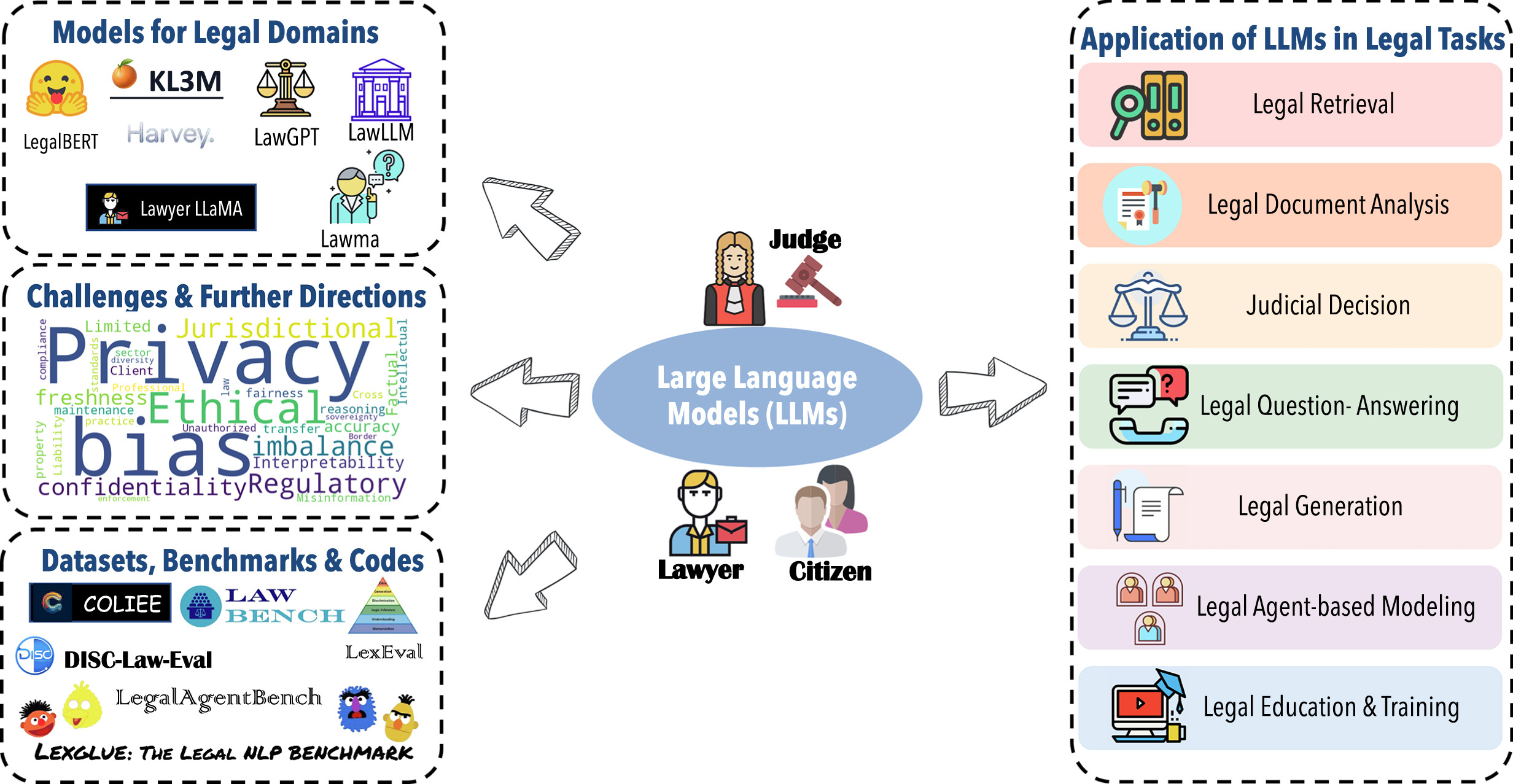
A Survey of Large Language Models for Legal Tasks: Progress, Prospects and Challenges
Congqing He, Haichuan Hu, Yanli Li, Hao Zhang, Quanjun Zhang
Computer Science Review (2026), JCR Q1, 中科院1区TOP, IF: 12.7
SolEval: Benchmarking Large Language Models for Repository-level Solidity Smart Contract Generation
Zhiyuan Peng, Xin Yin, Rui Qian, Peiqin Lin, YongKang Liu, Hao Zhang, Chenhao Ying, Yuan Luo
Proceedings of the 2025 Conference on Empirical Methods in Natural Language Processing (EMNLP 2025), CCF B
Enhancing Classroom Behavior Recognition with Lightweight Multi-Scale Feature Fusion
Chuanchuan Wang, Ahmad Sufril Azlan Mohamed, Xiao Yang, Hao Zhang, Xiang Li, Mohd Halim Bin Mohd Noor
Computers, Materials & Continua (2025)
Text Classification Based on Optimization Feature Selection Methods: A Review and Future Directions
Osamah Mohammed Alyasiri, Yu-N Cheah, Hao Zhang, Omar Mustafa Al-Janabi, Ammar Kamal Abasi
Multimedia Tools and Applications (2025)
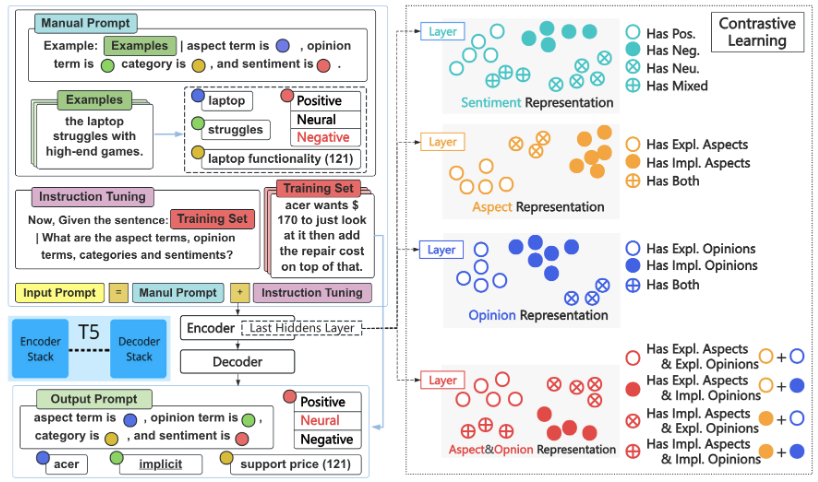
Hao Zhang, Yu-N Cheah, Congqing He, Feifan Yi
Findings of the Association for Computational Linguistics: EMNLP 2024, CCF B
Hao Zhang, Yu-N Cheah, Osamah Mohammed Alyasiri, Jieyu An
Artificial Intelligence Review (2024)
Improving Targeted Multimodal Sentiment Classification with Semantic Description of Images
Jieyu An, Wan Mohd Nazmee Wan Zainon, Zhang Hao
Computers, Materials & Continua (2023)
🤖 Projects
Live platform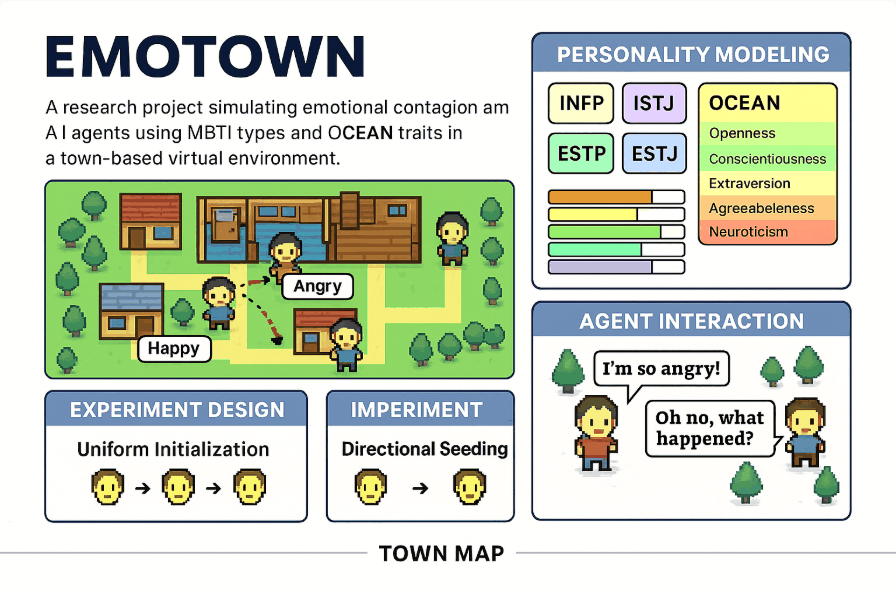
EMOTOWN: Emotion Town — Simulating Emotional Contagion among LLM Agents
EMOTOWN is a town-based multi-agent simulation platform for studying how emotions propagate through a population of LLM-driven agents. Every agent carries a personality profile — an MBTI type plus a Big Five (OCEAN) trait vector over openness, conscientiousness, extraversion, agreeableness and neuroticism — which governs how strongly it expresses emotion and how susceptible it is to others. In the uniform-initialisation setting all agents start from an identical emotional state, so any divergence is attributable purely to interaction-driven contagion and empathy; directional seeding instead injects an emotion at a single agent and traces how it spreads across the town.
This is where my AI-simulation background comes in. My core research extracts fine-grained affect from text — aspect-based sentiment analysis (ABSA), aspect-category-opinion-sentiment quadruple extraction (ACOSQE) and aspect sentiment quad prediction. EMOTOWN moves the same question up one level: from what emotion does a piece of text carry? to how do emotions travel between agents, and what does that reveal about social dynamics and machine emotional intelligence? The platform combines agent-based simulation, affective computing and LLM-driven dialogue, and it bridges my sentiment-analysis research with the embodied-agent work at X.Lab, where socially aware agents have to share physical space with people.
🎖 Honors and Awards
- 2024. X.Lab Year Star, XU & X.lab.
🤝 Academic Services
Serving as a reviewer for multiple SCI/EI journals and top AI conferences.
Journals: Discover Artificial Intelligence, Cluster Computing, The Journal of Supercomputing, Frontiers in Communication, IEEE/ACM Transactions on Audio, Speech, and Language Processing.
Conferences: NeurIPS 2026, KDD 2027.